Imagine if there were constant sources of food readily available to you if you just knew where to look.
Guess what? This is no fantasy! Edible fruits do exist all arounds us, and this was the topic of “Forest To Table: Edibles From The Urban Forest,” a recent panel discussion hosted by Trees Atlanta.
What is a pawpaw?


I had no idea what a pawpaw was when I first sat down for the presentation. Thanks to the first speaker, Andy Moore, now I do. I also have a newfound appreciation for this forgotten fruit.
The pawpaw happens to be the largest edible native fruit in North America. Once prized for its sweet creamy taste by such notable personalities as Thomas Jefferson and Lewis and Clark, the pawpaw has largely fallen out of the public’s consciousness. Andy discusses the economic and cultural reasons why in his new book, PawPaw: In Search Of America’s Forgotten Fruit.
Pawpaw fruits were passed around the room. I found them to have a pleasant, melon-like aroma. Andy described the taste as a cross between mango and banana. The fruit works particularly well in frozen desserts such as ice cream and gelato. The pawpaw seems to be slowing making a revival. Several towns regularly hold papaw festivals, and a few farmers are trying to produce pawpaws on a commercial sale. It really was a revelation to learn that a tasty fruit that I had never even heard of was natively growing all over the country.
“Where food is found, communities grow.”


Robert Hamiltion, otherwise known as the “Atlanta Fruit Man” posed a few questions to the audience to get us thinking about fruits from a different perspective. Why does such a wide variety of native fruits like the pawpaw exist, but yet only a small fraction have been bred into production? Robert challenged us to rethink the way we approach fruit. Instead basing the value of a fruit by the way it tastes right of the plant, we should consider how the flavor transforms after preparation or the way it combines with other flavors.
Lastly Robert highlighted the historical and cultural importance of trees, and in particular fruit trees. The history of a geographic location can be traced through the trees planted as a food source by those who settled there. The planting of a fruit tree truly is a gift for the generations to come.
Edibles are not for humans alone.
The final speaker of the evening was Cindy Mayer from the Atlanta Audbon Society. She works with homeowners in establishing their properties as a habitat for wildlife. Cindy highlighted the importance of selecting a diverse range of native plants when trying to attract animals. She also addressed the fact that homeowners will often encounter resistance when dealing with their HOA, but through patience and persistence they can often find some common ground. Building some form of wildlife sanctuary on their properties can be an achievable project for most anyone.
A sip of shrub

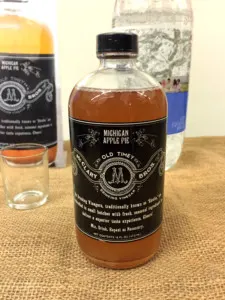
After and informative Q&A session that included some lively discussion about how to attract chipmunks to your yard, I capped off the evening by sampling some drinking vinegar, or “shrub”, courtesy of McClary Bros.
Shrub, a drinkable vinegar-based syrup, was a common cocktail mixer back in colonel times. The flavor that I sampled involved apple cider vinegar, cane sugar, and spices. I’m a regular drinker of apple cider vinegar on it’s own, so naturally I found the shrub to be a delectable treat. I can best describe it as a combination of apple vinegar and apple cider. It would be amazing paired with club soda or anything involving bourbon.
Recap & Mission
I left the discussion with new perspective on how we look at fruits. There is a whole world of native edibles to explore, and there is so much available to us right in our own backyards. I also now have two missions. One is to find some pawpaws while I am out hiking about both urban and secluded forests and create a dish using them. The other is to score some shrub for my next cocktail party (sources tell me it is available at Green’s on Ponce).